Search

Stainless Steel Hot Water Tanks

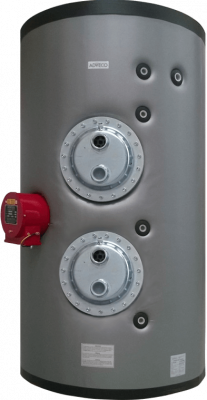
The Adveco range of stainless steel hot water tanks is constructed from high-grade AISI 316L austenitic stainless steel and includes models from 200 to 2500 litres. The stainless steel range is suitable for use as hot water buffers, single coil, or dual coil calorifiers as required for the application.

Kiwa WRAS approved product from Adveco

Features & Key Technologies

Options

The range consists of three types of vessel, differentiated by the number of internal heat exchange coils included as standard.

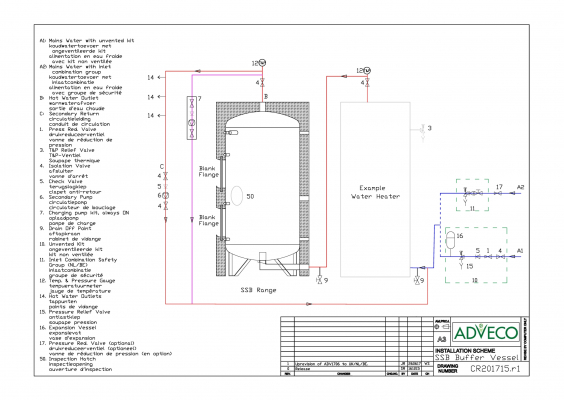
The Stainless Steel Buffer (SSB) range serves as buffer vessels only, and are supplied with two blank flanges without any internal heat exchange coils. The SSB range can be used to expand the dump load capacity of a water heating installation.

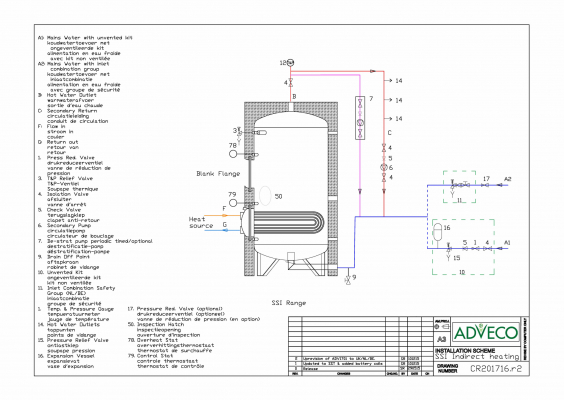
The Stainless Steel Indirect (SSI) range is supplied with a single high-output internal heat exchange coil at low level to serve as an indirect calorifier in DHW installations.

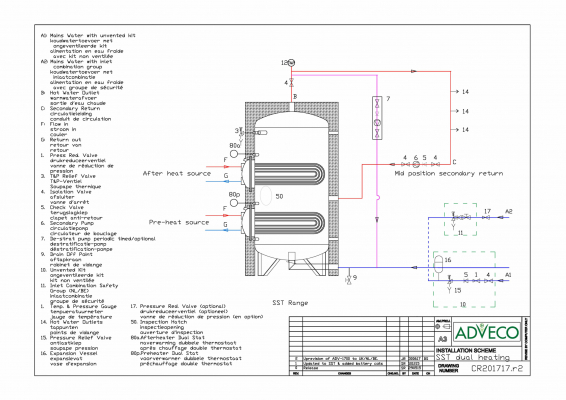
The Stainless Steel Twin-Coil (SST) range is supplied with a pair of independent internal heat exchange coils to serve domestic hot water systems. Each high-output coil can be used with a separate heat source, enabling effective integration of renewable technologies or multiple heat sources, or alternatively can be combined to increase the heat transfer capacity from a single high-output source.

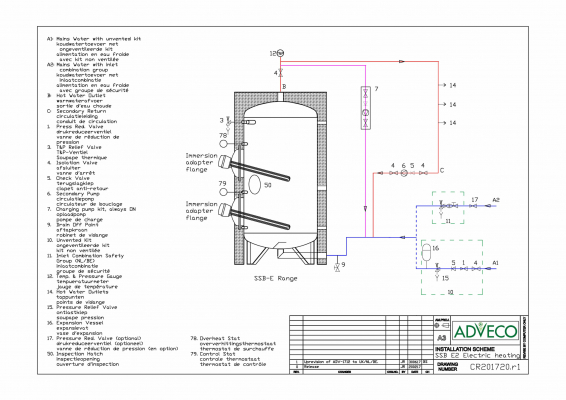
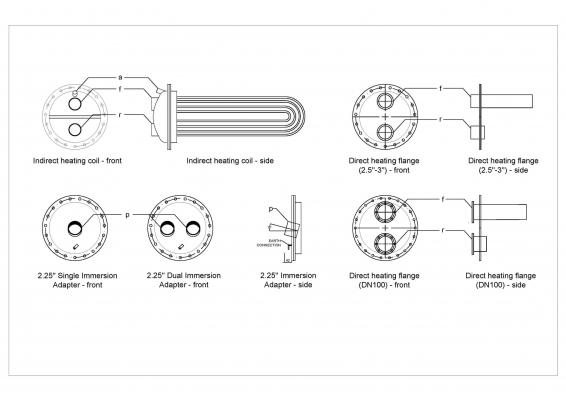
By adding specialised flanges instead of blanks, two subtypes of the SSB buffer vessel are also available: The SSB-E electric water heater, and the SSB-D direct buffer.

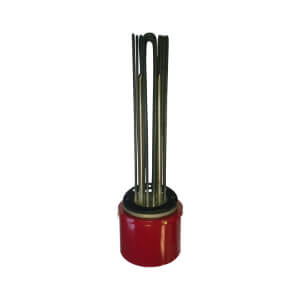
Stainless Steel Buffer Electric (SSB-E): One to two-element mounting flanges can be used to house up to four primary immersion heaters in addition to the aforementioned backup immersion heater, delivering electrical heating outputs of up to 84 kW with inbuilt redundancy.

Stainless Steel Buffer Direct (SSB-D): By using a specialised flange in the lower port of the SSB, direct large-bore flow and return connections can be made to a water heater.

Additional Information

Further information relating to each specific range of stainless steel vessel can be found in the associated product data-sheet.

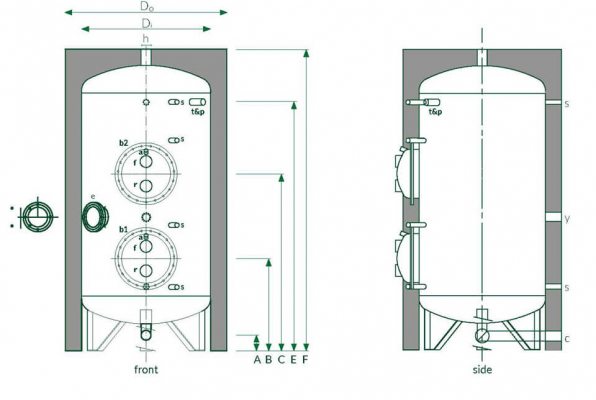
All coils and flanges featured within the stainless steel range can be removed for ease of cleaning, maintenance, and replacement. Multiple sizes and capacities of coils are available, enabling Adveco Ltd. to design a tank to fit the DHW demand or available boiler output of a building. An additional mid-level side opening is included on each tank, which can optionally be supplied with an extra immersion heater to provide a level of redundancy to a water heating installation.

The complete range of SSB, SSI, and SST stainless steel hot water tanks are WRAS approved, are designed and manufactured to the requirements of the Pressure Equipment Directive (97/23/EC), and are tested to the procedure defined in BS EN 12897:2006.

Are stainless steel hot water cylinders any good?

Short answer: yes, and at commercial scale they’re often the better choice. Stainless steel cylinders resist corrosion without relying on a lining, hold up well in both hard and soft water, and typically need less ongoing maintenance than a carbon steel equivalent, which means fewer callouts and a longer working life over the vessel’s lifetime. That makes them a strong specification wherever corrosion resistance, redundancy, or hot water continuity really matter. The full comparison against copper is below.

The problem this range solves

Some buildings can’t tolerate hot water going down, hospitals, labs, care homes, anywhere with vulnerable occupants or continuous operations. And some buildings sit in water conditions, soft, corrosive, or simply unpredictable, that shorten the working life of a standard carbon steel cylinder faster than the maintenance budget can absorb.

This range answers both problems from one base product. Redundancy comes built in: every tank has a spare mid-level opening for a backup immersion, and SSB-E takes that further with up to four immersions and 84kW of built-in backup, so a single element failure doesn’t mean a building without hot water. Corrosion resistance comes from the material itself, AISI 316L stainless steel doesn’t rely on a lining that can wear through, so it holds up in water conditions that would eat away at a lesser tank over the same working life.

Additional Information

Every coil and flange in the stainless steel range can be removed for cleaning, maintenance, and replacement. Multiple sizes and capacities of coil are available, so Adveco can design a tank to fit the DHW demand or available boiler output of a building. An additional mid-level side opening is included on each tank, which can optionally take an extra immersion heater for built-in redundancy.

The full SSB, SSI and SST range is WRAS approved, designed and manufactured to the requirements of the Pressure Equipment Directive (97/23/EC), and tested to the procedure defined in BS EN 12897:2006.

Flexibility and redundancy

Stainless steel is a genuine alternative to enamel or glass-lined carbon steel tanks, particularly where corrosion resistance, coil flexibility, or built-in redundancy matter more than upfront cost. This range, built from high-grade AISI 316L austenitic stainless steel, is designed around modularity: the same base vessel can be specified as a plain buffer (SSB), a single coil calorifier (SSI), or a twin coil calorifier (SST), simply by changing which flanges and coils are fitted, rather than needing a different product for each configuration.

Two further SSB subtypes, SSB-E and SSB-D, extend that flexibility. SSB-E supports up to four primary immersion heaters delivering up to 84kW with inbuilt redundancy, useful where hot water continuity is critical and downtime isn’t an option. SSB-D allows direct large-bore flow and return connections for simpler integration with an existing water heater. All coils and flanges across the range are removable, making maintenance, cleaning, and future reconfiguration straightforward rather than requiring vessel replacement.

The full range is WRAS approved, manufactured to the Pressure Equipment Directive (97/23/EC), and tested to BS EN 12897:2006, giving specifiers confidence the vessel meets UK compliance requirements regardless of which configuration is chosen.

Stainless steel vs copper hot water cylinders

Copper has been the default cylinder material for decades, and for domestic-scale hot water it still does the job well. At commercial scale, though, stainless steel has some real advantages worth knowing about before you specify.

Corrosion resistance. Copper corrodes in some water conditions, particularly where water is acidic or has high chlorine content, and pinhole leaks are a known failure mode on ageing copper cylinders. AISI 316L stainless steel, the grade used across Adveco’s stainless steel range, resists this far better, which matters more as vessel size and installation cost both scale up commercially.

Weight and installation. Stainless steel cylinders are generally lighter than an equivalent copper vessel of the same capacity, which can matter for plant room access, floor loading, and crane or lift constraints on retrofit projects.

Value over the vessel’s life. Stainless steel pays back its purchase price over time: less anode protection needed, and fewer of the corrosion-driven failures that shorten a copper cylinder’s service life in harder or more aggressive water conditions. Copper is the lower upfront cost of the two, which keeps it a sensible choice for smaller installations.

Where copper still makes sense. For smaller domestic or light commercial installations with benign water conditions and a tighter budget, copper remains a perfectly reasonable choice. It’s really at commercial scale, longer design life, and less forgiving water conditions where stainless steel shows its value.

If you’re weighing up the two for a specific project, get in touch and we can talk through the water conditions and demand profile involved.

Stainless Steel Hot Water Tanks

Technical Specifications & Downloads

Literature

View table as a PDF (58kb)

Model
Storage Capacity [l]
Tank Inlet and Outlet Connection Sizes [in]
Vessel Dimensions incl. Insulation (OD x H) [mm]
Heating Coil Capacities [kW]
Standing Losses [W]
Energy Efficiency Class
SSB, SSI, SST 200
191
1.25
650  x 1445
18 – 36
75
C
SSB, SSI, SST 300
286
1.50
700 x 1735
18 – 36
96
C
SSB, SSI, SST 500
481
1.50
850  x 1785
27 – 54
100
C
SSB, SSI, SST 800
758
2.00
1050 x 1865
27 – 108
120
C
SSB, SSI, SST 1000
939
2.00
1050 x 2195
90 – 180
143
C
SSB, SSI, SST 1500
1413
2.00
1260 x 2250
72 – 216
158
C
SSB, SSI, SST 2000
1989
2.00
1510 x 2090
72 – 216
190
C
SSB, SSI, SST 2500
2522
2.50
1660 x 2180
72 – 216
208
C
drop

Contact Us

Product brochure

Adveco Hot Water Specialists - 2024 Product Guide

Frequently Asked Questions

Yes, particularly at commercial scale. They resist corrosion better than carbon steel or copper, need less ongoing maintenance, and hold up in both hard and soft water, which adds up to a longer working life and fewer callouts over time.
SSB is a buffer vessel with no internal coil. SSI has a single coil at low level for one heat source. SST has two independent coils, letting you use two separate heat sources, such as a renewable source alongside a conventional one, or combine both for higher heat transfer from one source.
Yes. Every tank has a mid-level side opening that can take an extra immersion heater for built-in backup, and the SSB-E variant can house up to four primary immersion heaters, giving heating outputs up to 84 kW with inbuilt redundancy, useful for buildings that can’t afford hot water downtime.
Yes, the AISI 316L stainless steel construction suits both soft and hard water applications, and all coils and flanges can be removed for cleaning and maintenance if scale does build up over time.
SSB-E is an electric configuration, using one to two element mounting flanges to house up to four primary immersion heaters plus a backup, for up to 84kW output with redundancy built in. SSB-D allows direct large-bore flow and return connections to an existing water heater instead.
The full SSB, SSI, and SST range is WRAS approved, manufactured to the requirements of the Pressure Equipment Directive (97/23/EC), and tested to the procedure defined in BS EN 12897:2006.
Yes, particularly at commercial scale. Stainless steel resists corrosion better than copper, especially in acidic or high-chlorine water, is generally lighter for the same capacity, and needs less anode protection over its working life. Copper is cheaper upfront and remains a reasonable choice for smaller, lower-demand installations.


Longer than carbon steel or copper equivalents in most water conditions, since the corrosion resistance comes from the material itself rather than a lining or coating that can eventually wear through. Actual working life still depends on water quality, usage, and maintenance.
 
No, not in the same way. AISI 316L resists corrosion at the metal itself, so it doesn’t rely on anode protection the way carbon steel does. That’s part of why maintenance requirements are lower across this range.
 
It varies by model and configuration, particularly for SSB-E and SSB-D with their specialised flanges. Get in touch with your project timeline and we’ll confirm what’s achievable.


Why Choose Adveco

fifty-year-history-logo

50 Years

Adveco Ltd. is the independent hot water specialist for the commercial built environment and has historically traded as A.O. Smith Water Heaters in the UK.

highest-quality-products-and-services-logo

Highest quality products and services

We prioritise our clients’ needs to deliver bespoke, practical systems.

full-after-sales-support-logo

Full aftersales support

Maintenance and service packages, commissioning, spares, warranty and technical support for your application.